My daughter often talks about alicorns and sometimes pretends to be an alicorn. That's a cross between a pegasus and a unicorn, i.e. a unicorn with wings. So why can't she just be a unicorn with wings? Because unicorns don't have wings, of course. Not real unicorns (according to My Little Pony, that is, and perhaps other sources as well).
Someone who is asked how to kill a vampire will probably say a stake through the heart, and perhaps will mention other methods; but will most likely not qualify the statement with anything like "typically" or "according to the majority of popular sources." When it comes to some of the finer points of vampire mythology, like whether they can survive in sunlight, there is significant disagreement among popular sources (The Hunger: yes; Buffy the Vampire Slayer: no; Twilight: yes, but they prefer to avoid direct sunlight because it makes them glitter conspicuously). It wouldn't be unheard of for vampire geeks to argue about such things without acknowledging that they are really arguing about which mythology is the dominant one, or which mythology each person prefers. Like when I was talking to someone who claimed that "Elvish" and not "Elfish" is the correct way to refer to the language of elves. ("Says who?" I said. "You realize elves aren't real, right?")
Consider, by way of contrast, Sherlock Holmes. He is no more real than unicorns, vampires, or elves, but if you want to know his address, there is a definitive answer. Or at least there is an answer that virtually everyone can agree on, because virtually everyone would agree that Arthur Conan Doyle is the definitive source. This even though there may very well be fan fiction out there in which Holmes lives at 221A Baker Street, or 1600 Pennsylvania Avenue, or wherever. In the same vein, one can confidently claim that J.R.R. Tolkien is the definitive source for information about hobbits. He did invent them, after all. There is much more room for argument about elves (and orcs, and all kinds of other stuff), not least because there won't be universal agreement about what "definitive" even means. (Tolkien also capitalizes the names of these races, but I'm not on board with that. Languages, on the other hand, even made-up ones, should be capitalized, imo.)
Here comes the tortured analogy. Nowadays, knowledge is viewed more like the mythology of vampires or elves than that of Holmes or hobbits. I think that's fair to say. There is good reason to view results of scientific research as authoritative (which is not to say infallible), whereas arguing over whether one non-scientific source is
more authoritative than another tends to boil down to declaring
allegiance to something--an ideological group, a way of thinking, a set of values, etc. Which is something like claiming that one depiction of vampires (or elves or unicorns) is "right" and another "wrong." Far from a perfect analogy, but what the hell.
Showing posts with label debate. Show all posts
Showing posts with label debate. Show all posts
Thursday, May 8, 2014

Wednesday, April 16, 2014
God and null hypotheses
Comedian Tim Minchin performs a song, "Thank You God," prefatory to which he tells a story about meeting a fan of his who is a Christian. When asked why he does not believe in God, Minchin says this is part of a more general policy of only believing things for which he has evidence. What he does not acknowledge is that there also is no evidence that God does not exist. Don't get me wrong: I do enjoy the man's comedy. However, if we're being scientific about this, we start with one of two null hypotheses--God exists, or God does not exist--and we cannot reject either. One might argue that one of those hypotheses is the more reasonable starting point, but it is incorrect to claim that the lack of evidence is an unconditional indication that God does not exist (although, to be fair, I'm not completely sure Minchin was trying to make that claim; maybe he was standing up for agnosticism rather than atheism).
Scientists of all kinds avoid any confusion over the conclusions of research by stating the conclusions carefully. You'll often hear the statement, "There is no evidence that [blank]," which basically means that if we start with the assumption [not blank], we don't have enough evidence to reject that assumption with any reasonable degree of certainty. That could be the case after hundreds of peer-reviewed studies have attempted to demonstrate [blank], or it may be that no one has even tried. Either way, "There is no evidence that [blank]" is not at all the same claim as "There is evidence that [not blank]" and should not be treated as such. Case in point: when my firstborn was an infant, I heard from more than one source that there is no evidence that allowing a baby to "cry it out" causes any lasting psychological damage, but I wasn't about to let my son cry for hours at a stretch.
I think it is common for null hypotheses to go unnoticed or unacknowledged. There's always some kind of default belief. Consider the vaccination scare, still active in some quarters. I don't think that childhood vaccinations cause autism, and that conclusion is predicated on the belief that we shouldn't think that vaccines cause autism unless we have some good reason to do so. One could take the opposite belief as the default, once the possibility of a connection is raised: that vaccinations do cause autism, or some other kind of harm, unless we have strong reason to believe otherwise. I'm not sure if that belief is thoroughly unreasonable, but it is certainly subject to criticism. Such as: given all of the potential causes and potential effects in the universe, any pair chosen at random are extremely unlikely to be related, and therefore the reasonable default belief is that there is no causal relationship between any pair of randomly chosen events. And why are we focusing on autism in particular? Why not other disorders or diseases, or even positive effects, for that matter? Why not take the default belief to be that childhood vaccines cause pattern baldness later in life? And so forth. Apart from the reasonableness of the null itself, adopting the wrong null is costly if there is insufficient evidence to reject the null. If you avoid vaccines because you believe they cause autism, you risk disease that vaccines can prevent (and we have very good evidence for that).
Back to Tim Minchin: it hardly makes sense not to believe anything without evidence. A more defensible statement is that one will not deviate from some kind of baseline beliefs without sufficient evidence. Then the origin of these baseline beliefs becomes the issue. These baseline beliefs are often unstated and may even be subconscious. I doubt that the anti-vaccination crowd is thinking things through in the way I describe above. Opposition to vaccinations may arise from a fundamental belief in the ability of the human body to heal itself under some kind of natural conditions, or from a distrust of the medical establishment's ability to improve health in a substantive way. I suspect that anyone considering the vaccination question has some kind of predisposition toward one side of the debate or the other, and that this predisposition often goes unarticulated.
I can imagine all kinds of baseline beliefs that fuel conflict over social and political issues. For example:
Tim Minchin's disbelief in God is a matter of faith. Nothing wrong with that, and he can try to argue that this belief is somehow better or more reasonable than the opposite belief. But he can't claim that he is on the side of objective truth.
Scientists of all kinds avoid any confusion over the conclusions of research by stating the conclusions carefully. You'll often hear the statement, "There is no evidence that [blank]," which basically means that if we start with the assumption [not blank], we don't have enough evidence to reject that assumption with any reasonable degree of certainty. That could be the case after hundreds of peer-reviewed studies have attempted to demonstrate [blank], or it may be that no one has even tried. Either way, "There is no evidence that [blank]" is not at all the same claim as "There is evidence that [not blank]" and should not be treated as such. Case in point: when my firstborn was an infant, I heard from more than one source that there is no evidence that allowing a baby to "cry it out" causes any lasting psychological damage, but I wasn't about to let my son cry for hours at a stretch.
I think it is common for null hypotheses to go unnoticed or unacknowledged. There's always some kind of default belief. Consider the vaccination scare, still active in some quarters. I don't think that childhood vaccinations cause autism, and that conclusion is predicated on the belief that we shouldn't think that vaccines cause autism unless we have some good reason to do so. One could take the opposite belief as the default, once the possibility of a connection is raised: that vaccinations do cause autism, or some other kind of harm, unless we have strong reason to believe otherwise. I'm not sure if that belief is thoroughly unreasonable, but it is certainly subject to criticism. Such as: given all of the potential causes and potential effects in the universe, any pair chosen at random are extremely unlikely to be related, and therefore the reasonable default belief is that there is no causal relationship between any pair of randomly chosen events. And why are we focusing on autism in particular? Why not other disorders or diseases, or even positive effects, for that matter? Why not take the default belief to be that childhood vaccines cause pattern baldness later in life? And so forth. Apart from the reasonableness of the null itself, adopting the wrong null is costly if there is insufficient evidence to reject the null. If you avoid vaccines because you believe they cause autism, you risk disease that vaccines can prevent (and we have very good evidence for that).
Back to Tim Minchin: it hardly makes sense not to believe anything without evidence. A more defensible statement is that one will not deviate from some kind of baseline beliefs without sufficient evidence. Then the origin of these baseline beliefs becomes the issue. These baseline beliefs are often unstated and may even be subconscious. I doubt that the anti-vaccination crowd is thinking things through in the way I describe above. Opposition to vaccinations may arise from a fundamental belief in the ability of the human body to heal itself under some kind of natural conditions, or from a distrust of the medical establishment's ability to improve health in a substantive way. I suspect that anyone considering the vaccination question has some kind of predisposition toward one side of the debate or the other, and that this predisposition often goes unarticulated.
I can imagine all kinds of baseline beliefs that fuel conflict over social and political issues. For example:
- People are basically good (or bad)
- Government agencies are generally corrupt (or trustworthy)
- Life on Earth is generally getting better (or worse)
Tim Minchin's disbelief in God is a matter of faith. Nothing wrong with that, and he can try to argue that this belief is somehow better or more reasonable than the opposite belief. But he can't claim that he is on the side of objective truth.
Friday, March 7, 2014
Ask a libertarian
Next time I encounter a libertarian who opposes some specific policy, like a gun-control measure or a financial regulation, I want to ask: do you oppose requiring cars to have license plates?
Wednesday, November 20, 2013
Is everything debatable?
Near the beginning of this semester, in my macro
principles class, we were talking about all the reasons why economists might
disagree. Belief in different theories or methodologies, differing
interpretations of evidence, and differences in values or priorities: these
pretty much capture everything, I think, although you could elaborate on each
of these and delineate subcategories. During this discussion, one of my
students asked, "So, in economics, is everything debatable?"
Friday, July 19, 2013
What's wrong with public debate, part 3
A follow-up to part one and part two. I see three layers in debates over political or social issues: the bottom layer is some fundamental issue that could be classified as one of Haidt's moral foundations, or one of Kling's three axes; the middle is the rhetoric used to defend the bottom layer; and the top layer is the conclusion about a specific situation.
Saturday, June 22, 2013
Circumspection and other virtues
In a previous post, I lamented the problems arising from the "well-intentioned propagation of misinformation." We would all be better off if everyone could just be less confident.
Saturday, May 25, 2013
Academics can be trolls too
Friday, April 26, 2013
What's wrong with public debate, part 2
A previous post sparked another frustrating Facebook debate. Remarkably, the most active participant (other than me) continued to do many of the things that I had criticized in the post, even though these very criticisms initiated the debate, and even though I repeatedly pointed out that he was doing this. He never took issue with the items in the post itself; he just continued to provide examples of unreasonable, non-constructive debating tactics (inadvertently, I presume).
Regarding gun control specifically, these tactics do nothing to foster understanding between opponents, not to mention consensus of any kind. Still, to me, the more interesting and important issue is the nature of the debate itself. It may be understandable that people argue in nonsensical, counter-productive ways without realizing it, but it’s harder to understand, and to defend, when these things are at the forefront of the conversation. Limitations on cognitive ability or effort may provide part of the explanation, but not all of it. It is becoming increasingly clear that there is something other than pure reasoning going on: see, for example, Haidt's elephant and rider analogy, Kahneman's system 1 vs. system 2 thinking, Lakoff's metaphors and frameworks, or Kling's three axes model. I am nonetheless surprised to see the aggressive opposition to reason that I have encountered recently, and I wonder how typical it is.
Clearly we don't understand these psychological issues entirely, and if everyone could be aware of the things we do understand, we wouldn't have agreement on every issue that is currently contentious; but it would be clear where the disagreements really lie, and surely some areas of disagreement would be eliminated, if we were all on the same page about how the reasoning is actually happening. So should we strive toward greater enlightenment as a means of resolving (or reducing) conflict over public policy? I'm inclined to think that this is unrealistic. More likely we as a society will have to take these weirdnesses in mental processing as given and do the best we can in the face of them. For example, rules of evidence can be viewed as a means of managing jurors' potential irrationality, rather than trying to break through it (or pretend it isn't there). I have new respect for this approach. What to do in broader contexts, I have no idea. Yet.
Regarding gun control specifically, these tactics do nothing to foster understanding between opponents, not to mention consensus of any kind. Still, to me, the more interesting and important issue is the nature of the debate itself. It may be understandable that people argue in nonsensical, counter-productive ways without realizing it, but it’s harder to understand, and to defend, when these things are at the forefront of the conversation. Limitations on cognitive ability or effort may provide part of the explanation, but not all of it. It is becoming increasingly clear that there is something other than pure reasoning going on: see, for example, Haidt's elephant and rider analogy, Kahneman's system 1 vs. system 2 thinking, Lakoff's metaphors and frameworks, or Kling's three axes model. I am nonetheless surprised to see the aggressive opposition to reason that I have encountered recently, and I wonder how typical it is.
Clearly we don't understand these psychological issues entirely, and if everyone could be aware of the things we do understand, we wouldn't have agreement on every issue that is currently contentious; but it would be clear where the disagreements really lie, and surely some areas of disagreement would be eliminated, if we were all on the same page about how the reasoning is actually happening. So should we strive toward greater enlightenment as a means of resolving (or reducing) conflict over public policy? I'm inclined to think that this is unrealistic. More likely we as a society will have to take these weirdnesses in mental processing as given and do the best we can in the face of them. For example, rules of evidence can be viewed as a means of managing jurors' potential irrationality, rather than trying to break through it (or pretend it isn't there). I have new respect for this approach. What to do in broader contexts, I have no idea. Yet.
Sunday, April 21, 2013
Too much and not enough
I've been thinking about informational issues for several years. Part of the motivation for this arose during the vaccination scare, which was at a fever pitch around the time my son was born.
Thursday, April 18, 2013
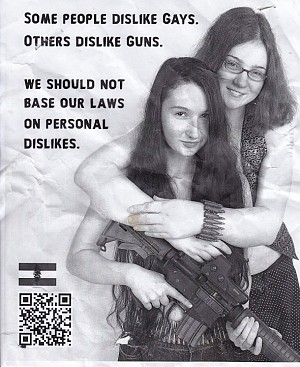
What's wrong with the gun-control debate (and public debate in general)
The debate over gun control frustrates me immensely, and
this has nothing to do with whether or not anyone supports any specific law
that I may or may not support. It's all
about how people defend their own opinion and criticize others' opinions. This debate is a good illustration of
problems that appear in public debate over lots of issues. After the jump is a (probably non-exhaustive)
list of tactics that aren't helping any.
Subscribe to:
Posts (Atom)